



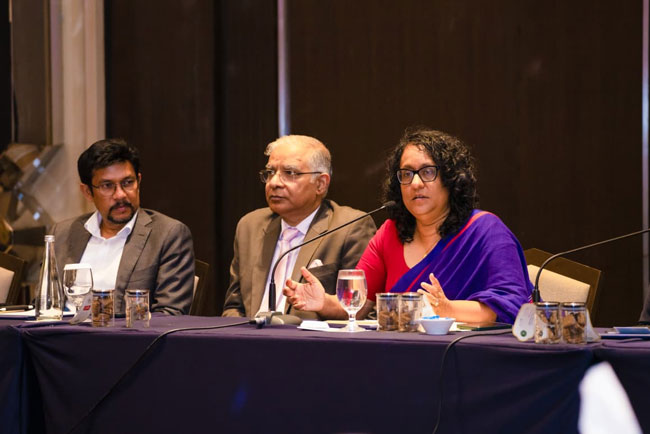
Sri Lankan Prime Minister Dr. Harini Amarasuriya has emphasized the country’s rapid recovery from recent floods and landslides, attributing the progress to the resilience and unity of its people.
“We have taken a blow, but we are far from fallen,” she said while addressing senior members of India’s NASSCOM Executive Committee and Sri Lanka’s SLASSCOM on 4 December in Colombo.
The meeting brought together NASSCOM—the apex body of India’s technology industry representing over 3,000 companies—and SLASSCOM, Sri Lanka’s chamber for the IT and BPM sector with over 350 member firms. Discussions focused on digital-economy partnerships, investment opportunities, and future collaboration in Sri Lanka’s ICT landscape, according to the Prime Minister’s Media Division.
Dr. Amarasuriya thanked the NASSCOM delegation for maintaining their annual visit despite the country’s recent challenges, calling their presence a strong signal of confidence in Sri Lanka’s stability.
She noted that the government, with support from the World Bank and the United Nations, is conducting extensive assessments to guide reconstruction and long-term disaster-preparedness efforts. Plans include resettlement, improved flood control, and major infrastructure upgrades.
Highlighting Sri Lanka’s economic trajectory, the Prime Minister reaffirmed the government’s medium- to long-term target of 7% economic growth. She identified export diversification and digital-economy development as priority areas where closer collaboration with India is expected.
The Prime Minister also outlined ongoing digital-transformation efforts within government institutions. The Ministry of Education’s National Education Management System is set to launch in January, with other ministries preparing their own platforms in the coming months.
During the meeting, an Indian technology company specializing in drones offered support to strengthen Sri Lanka’s disaster-response capabilities through mapping, geospatial analysis, and real-time monitoring. Dr. Amarasuriya welcomed the proposal, acknowledging the need for advanced early-warning technologies to manage future climate-related risks.
She further detailed regulatory and governance reforms aimed at positioning Sri Lanka as a competitive destination for global IT and BPM investments. The government’s goal is to grow the sector to USD 5 billion in export value by 2030, supported by education reforms and workforce development initiatives.
Sri Lanka is also working closely with India on major digital initiatives, including a universal digital ID system and integrated platforms such as the upcoming National Education Management System.
The NASSCOM delegation’s visit reflects a long-standing partnership with SLASSCOM and aligns with preparations for the 2026 NASSCOM Technology & Leadership Forum.
The event was attended by Deputy Digital Economy Minister Eranga Weeraratne, President’s Chief Digital Economy Advisor Dr. Hans Wijesuriya, Indian High Commissioner Santosh Jha, and representatives of both organisations.